| Comfort mode (°C): | +7° |
| Extreme mode (°C): | -4° |
| Insulation weight (g/sq.m): | 1 x 200 |
| Insulation: | Hollow Fiber |
| Outer fabric: | 190T Polyester + 210T Diamond Ripstop Poly |
| Inner fabric: | Freesoft 190T |
| total weight: | 1.4 kg. |
This is my first sleeping bag. I bought the cheapest one, because I spent all my money on boots and a tent))
The main and biggest advantage is the price of 2,000 rubles with a 50% discount at trial sport.
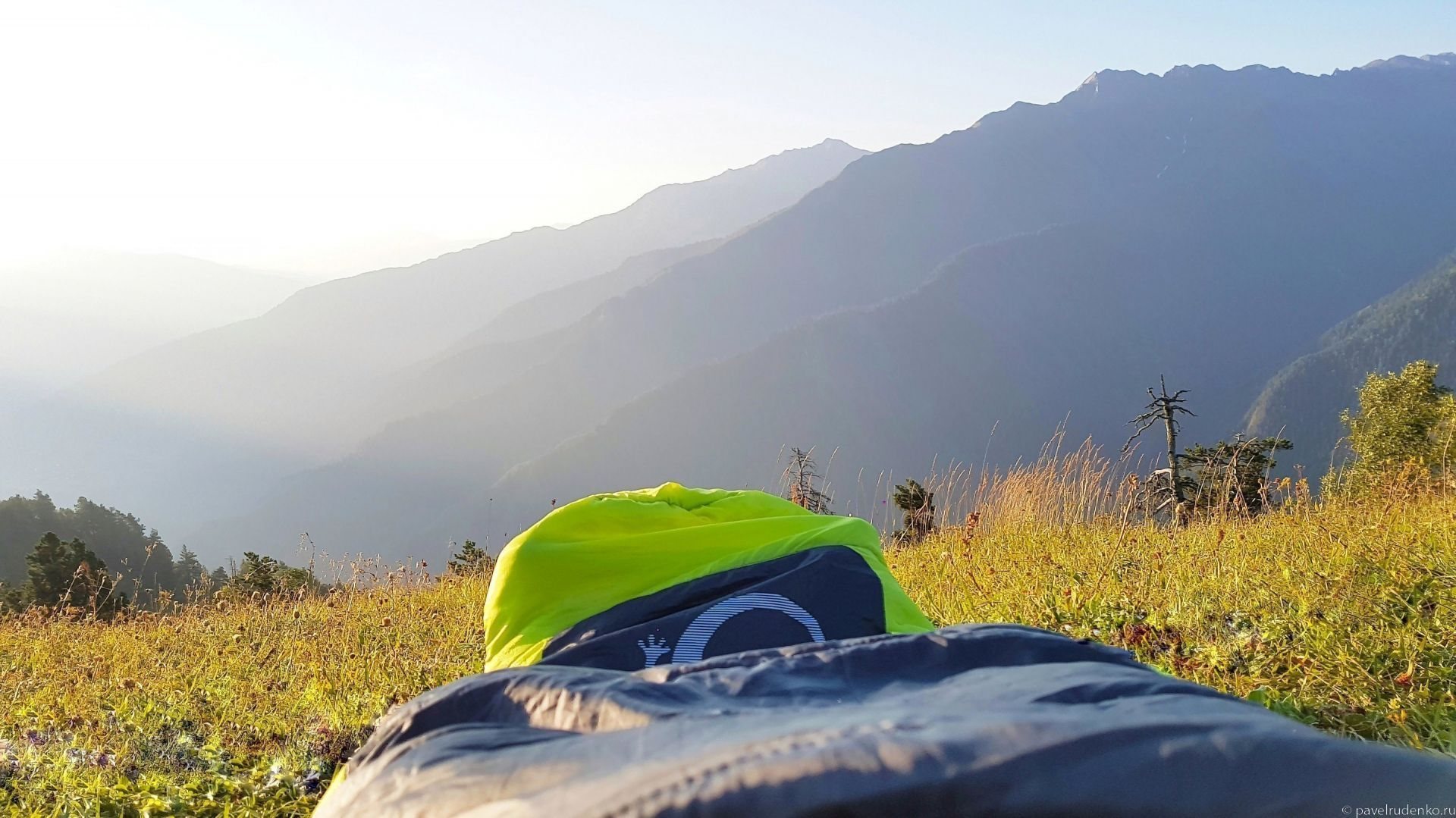
Naturally, with such a price, no one tested it according to EN 13537. So, we can only test it on ourselves. The experience described below is based on approximately 110 nights in a sleeping bag at altitudes from 0 to 3,000 meters above sea level at temperatures from +2° to +27°. on an Izhevsk mat 10mm thick, in a tent with a skirt, mostly alone. My height is 177 cm, weight is 65 kg.
The declared comfortable mode at +7°, provided that you sleep in thermal underwear, is correct for a man.
BUT, the value of +7° is also the maximum temperature of comfort. With an unforeseen cooling to +3°, with the skirt down, in thermal underwear and fleece, socks, gloves and a balaclava, I felt constant cold and interrupted sleep.
In the morning I put some clothes on top of the sleeping bag, a jacket and put my feet in the backpack, it got noticeably better, but the general state of discomfort remained.

The big disadvantage of the sleeping bag is its one “universal” size with a length of 220 cm. With my height, 20-25 cm are excessive - this is additional, useless weight and a cold part of the sleeping bag. It is impossible to heat this additional volume in the legs at a temperature of about +7°. I felt a “wall” of cold air in the area of my feet. I started stuffing it with clothes, the problem was partially solved, but such... In a word, it’s not a way out of the situation.

At outside temperatures above +10°, accordingly, I undress and unzip the zipper as the temperature rises, укрывшись спальником как одеялом. +7 is one of the universal, upper indicators of temperature. I don’t see the point in sleeping bags with a comfort temperature from +10° to +20°, at 15° nights they are warm enough, but there is always the risk of a cold snap and you can freeze to death with such bags.
When sleeping without clothes, the inside of the sleeping bag feels like something in between, it doesn’t irritate, but it’s not perceived as pleasant. I liked the white color at first, you can see bugs and spiders, but later it got dirty around the neck. I washed it once in the machine, the thermal properties of the sleeping bag were preserved.
The compression bag is good, despite the fact that all the inscriptions have worn off, it hasn’t torn, it does its job. When pulled tight, it’s compact.
I used Freetime LITE TECH 200 as a condensation bag a couple of times, wearing it over my main sleeping bag in winter, and even in this case it remained too long.
Conclusion: the sleeping bag is a summer, well-sewn, super budget solution with the main disadvantage being its large size. This is excess weight of 200-300 grams and heat loss, but the price makes up for all the shortcomings. If I could turn back time, I would take it again. I haven’t seen a less or more qualitatively alternative. If you have used it, please write in the comments.


