
ANIMALS
This is a separate section that can scare anyone, but forewarned is forearmed. I am not an expert; the information is collected from forums of fauna lovers and from open sources about animals, and then formulated by me into this article. This is not advice on how to behave in case of a bite or attack; you alone must decide what to do in such situations.
Snakes. Only the gyurza poses a direct threat to human life. In spring and autumn, it likes to look for prey in the places where migratory birds spend the night, setting an ambush in bushes and vineyards. Most registered bites occurred there. Usually active during the day, except in summer, when due to the heat it prefers a nocturnal lifestyle. It can be monochromatic: brown, dun and black, often with a purple tint. Sometimes covered with dark-brown spots. It lives from the desert to the mountain-steppe zone, no higher than 2,000 m. It is found in dry foothills, on slopes overgrown with shrubs, in rocky gorges with streams and on cliffs. When attacking, it jumps instantly to the length of its body. In case of a bite, it is necessary to evacuate to civilization immediately and seek medical help. The bite is fatal. Emergency number – 112.
I saw a half-meter snake near caves north of Tekirova. Hearing me from three meters away, it rushed away. Snakes are afraid of humans and, noticing them, crawl away. You need to give it an escape route. If it suddenly crawls towards you, then most likely there is its hole behind you. You need to step aside and clear the way for the snake.
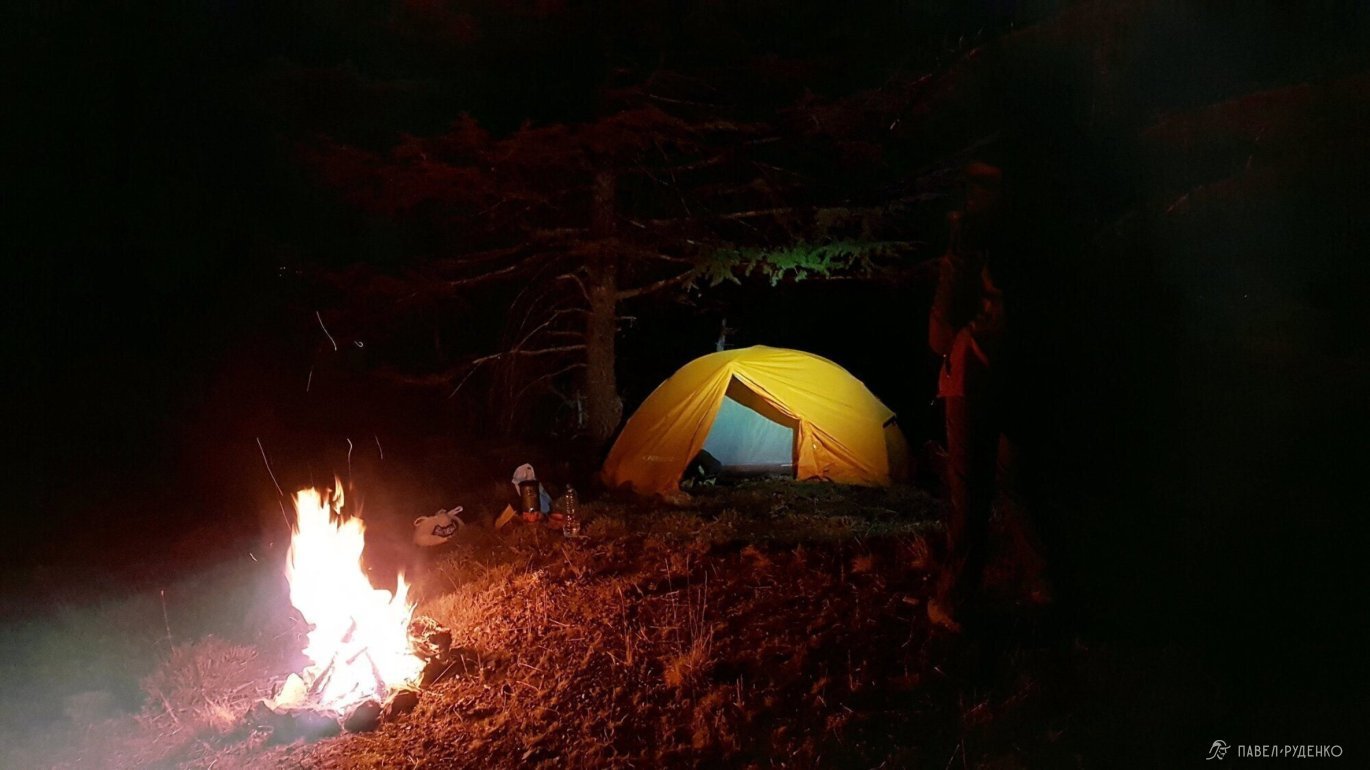
Scorpions. Like snakes, they do not attack unless disturbed, but they are not afraid of humans and can settle nearby. They can be sand-yellow and black, the darker and larger they are, the more poisonous they are. They sleep under rocks and branches. Be careful when setting up a tent or collecting firewood. On sandy beaches, they burrow under a thin layer of sand, one of the precautions is not to take off your shoes. They are active at night, so close your tents and zippers on your backpack. In the morning, check for "guests" in the cool apartments in the form of your shoes. The tail, where the stinger is located, is dangerous, not the pincers. For an adult with normal immunity, their venom is not fatal, but the risk increases if stung close to the head or a child.
The stinger causes severe pain, reminiscent of a burn. It lasts up to 12 hours, subsiding and then intensifying again. After 30-40 minutes, redness and swelling with a dark dot appear at the site of the bite, sometimes bubbles filled with clear liquid appear. Within 2 hours, itching appears, then skin sensitivity decreases. General symptoms can appear from 5 minutes to 24 hours. Characterized by agitation, a feeling of fear, headache, chills, heart pain, palpitations, shortness of breath, nausea. Later, agitation gives way to drowsiness and apathy.
Ticks. The fight against them in the 2000s led to a decrease in the population, now it is much smaller than in Crimea or Siberia. Encephalitis is practically not found, but ticks carry Lyme fever and Congo-Crimean fever. According to statistics, 500 cases of the disease are registered throughout Turkey every year, on average 5% of which are fatal. Ticks usually live in the grass, they like shade and damp places. For protection, use a spray, it significantly reduces their activity, tuck your pants into your socks and examine yourself in the evenings.
Wolves. The likelihood of encountering them on the Lycian Trail is very low, but when going in winter, I would take a hunter's signal or a flare. They live in mountainous areas, usually in packs, less often alone. Cases of attacks in winter have been recorded when, in search of food, wolves descended into the settlements. While hitchhiking, I often heard shots, especially in central Turkey. It turns out that locals install automatic guns that fire every 20 minutes, thereby scaring away the wolves. An attack on a hiker can happen for three reasons: rabies, hunger, territory defense. When meeting a wolf – do not run, without turning, back away, raise a jacket, backpack or hands above your head to seem bigger and scream loudly.
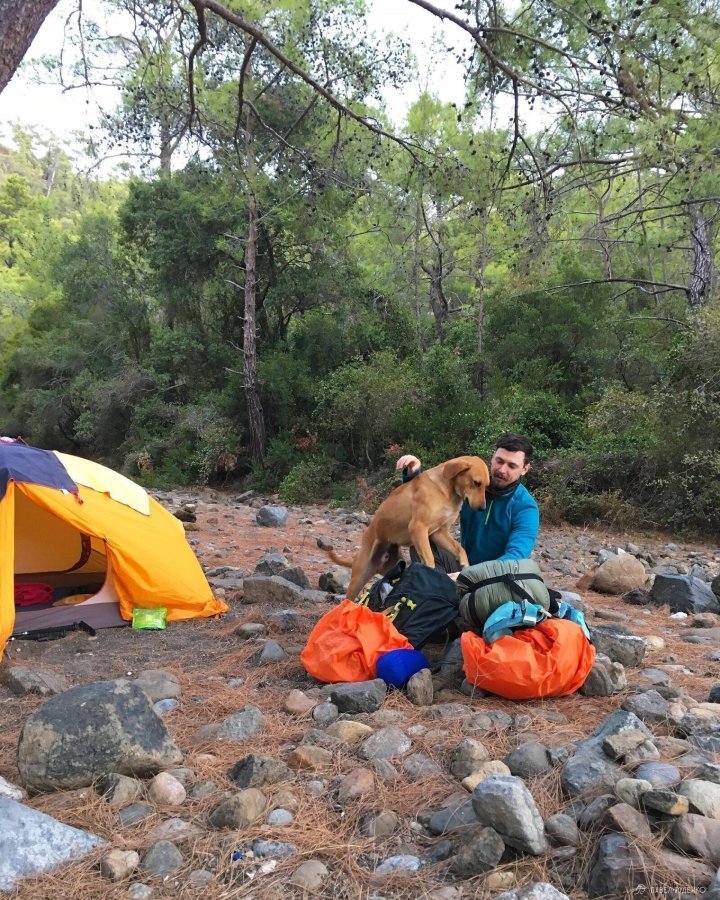
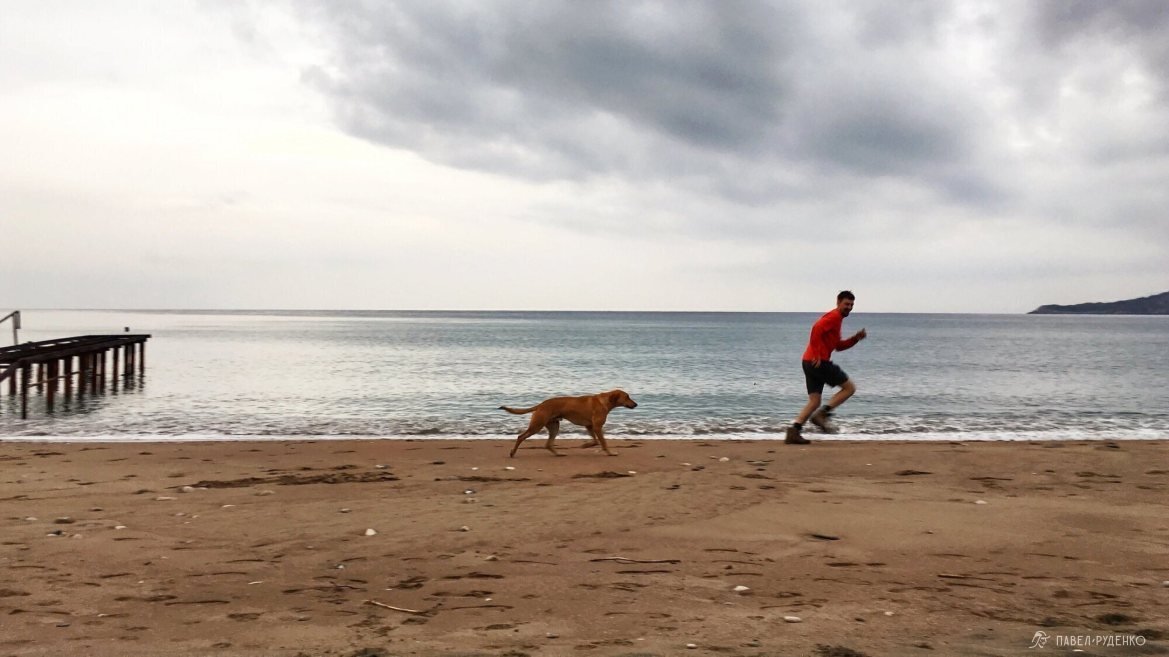
Dogs. There are many stray dogs, they are very friendly and accompany you along the trail, and at night they guard the tent. Just do not forget that a cute animal can carry various diseases dangerous to humans.
Owl, Tawny Owl. What those owls did during the overnight stay at Gayнюк and on the Takhtaly Pass cannot be described in words! 3-4 birds called out every minute, creating an incredible atmosphere. One of the most vivid impressions associated with wildlife! It is slightly larger than a crow, can turn its head 270°. The plumage is colored in camouflage gray, or the color of tree bark, so it is not easy to see them.
STORIES FROM THE HIKE
Good stories
Heading from the historic center of the city to the tram, I found that the ticket could not be bought at every stop. In Antalya, turnstiles are installed at the entrance to the stop itself. Seeing how puzzled I was looking around in search of a ticket office, local girls gave me their pass.
In one of the villages, I went to a cafe in search of bread. I had to explain for a long time what exactly I wanted – the owner did not know English, so, actively gesturing, I showed him the life path of a loaf almost from growing wheat to his counter. But the owner said that he keeps bread only for sandwiches and does not sell it separately. I, of course, smiled and was about to leave the cafe, when the owner ran out after me with a bag, filled, it seems, with all the baked goods he had! He categorically refused money, kind soul.
For Alena, this was the first hike, and when distributing responsibilities, she took on cooking. But halfway through, I took the gas cylinder and found that there was enough gas for a couple of times of cooking. When I cook myself, I use gas economically, constantly turning off the supply and maintaining the required temperature a little. But then I messed up and didn't explain properly how to regulate the gas supply. There was no way to buy gas, so I was thinking of going to the road and going to Antalya and back, but the universe is responsive: a few hours later, guys from Ukraine on the last day of their hike gave us their gas, for which we are very grateful and have a firm handshake.
Bad stories
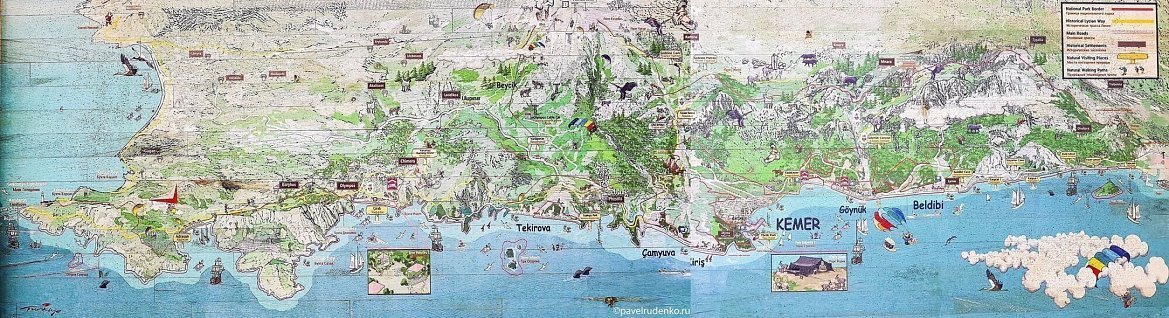
The most popular start of the route is from the eastern side, Gaynyuk, where we headed (the start from Gayikbayyry, where the climbing base is located, is less popular). Coming out at the turn to the canyon, I made a mistake: a mountain river flows here and, heading to the trail, you inevitably come to the payment point. We reached the beginning of the trail by 17:00, where a Russian-speaking employee told us that the entrance was paid. Explaining that we are not going to the canyon, but to a free trail, there was no reaction. We must pay, because we will pass 30 meters of their land! After 20 minutes of unsuccessful communication, I buy a ticket not to waste more time. But then the way was blocked by a man who declared that it was too late and we needed to stay here for the night, because they are responsible for us, and if something happens, like the brave Malibu lifeguards, they will go to the rescue, and the first campsite is 5 km away and other nonsense. Having wasted more time and nerves, we still broke through the cordon of divorce and by 17:30 got to the Lycian Trail. By 18:00 I had walked 1.5 km with an elevation gain of 200 m to the first campsite.
Descending to the Chimera lights, we quickly ran through. There was no official entrance or signs before the lights. Compared to the surrounding beauties, this curious natural phenomenon did not interest us much, so we ran past quickly. At the exit, there were cafes, from which a man suddenly ran out, shouting "ticket, ticket". Having found out what he meant, we said that we were going along the trail, at the entrance there was no information about the need to purchase a ticket, just as in their paper – only information about the entrance is indicated, not the exit. In order to intimidate, the security guard took me by the arm and began to threaten that he would call the police. We agreed to this, the car arrived in a minute – they are guarding this area. We talked to the police officer, conveyed that for us it is not a matter of money, but an approach in communication and attitude towards tourists. We failed to achieve our truth, but the police officer was very adequate and, having paid, we went further.
Stories about the weather
November 15. A cyclone came from the northwest, the temperature dropped by 5 degrees and almost all the days became cloudy and rainy. On the first day of the cyclone, the forecast spoke of severe thunderstorms. That evening I stopped on Cirali beach, fearing lightning, I put the tent away from the shore. The Mediterranean has its own characteristics, the wind blew all the thunderclouds into the sea and at night the horizon flashed very powerfully, but there was silence on the coast and it rarely drizzled.
September 5. On my previous trip, I stopped on a hill with a great view of Pamukkale. The weather was great, sunny, but hitchhiking took a long time, I got tired and decided to set up my tent in the afternoon to sleep for a couple of hours. I woke up to the wind, which was practically tearing the tilted awning, opened the zipper and saw a wild contrast of a black cloud and the snow-white tufa of Pamukkale. I had to urgently evacuate from the hill to the nearest forest, where the trees shielded me from the strong gusts.
September 9. On my previous trip, heading to Cappadocia and hitchhiking through the central part, I got caught in a terrible storm. After waiting for a ride in the field for a couple of hours, I suddenly got a hurricane out of nowhere. Around – thin stems of freshly planted bushes and that's it! I had to use the 'desperate stop': I ran out onto the road, gesturing intensely and twitching chaotically, scaring the cars that sped up when they saw me. After 5 minutes, the next driver, having rushed past, braked after 300 meters and began to reverse. This person saved my health, because literally 10 minutes later the storm intensified so much that visibility dropped to 5-10 meters, and all the cars stopped. Some drove into the ditch, others stopped right in the row.
Experience has shown that Turkey, washed by four seas, is very unpredictable in terms of weather. Strong winds come quickly and can not only prevent you from setting up a tent, but even knock down trees or worse, even at sea level, not to mention mountain areas. When hiking in any area of this country, it is better to always check the weather reports.
Well, friends, don't worry, let some mystery remain, and the beauty of the Lycian Trail will be a surprise for you!
DANGER
In winter and spring, when there is snow, closed goggles of category 3-4 protection are required. Regular glasses will not work: the sun can burn the retina, up to loss of vision or orientation in space, the snow reflects up to 80% of the rays. It is advisable to have spare glasses, as I lost them twice on two winter hikes))
Closer to summer, the sun is very strong, the nose and neck burn quickly. Take sunscreen SPF 40+ with you.
From the above, the possibility of sunstroke and large losses of sodium salts by the body, which exit with sweat, which affects the regulation and distribution of fluid in the body, follows. Use sports powders, tablets or replenish salt with food.
In the winter snowy months, on steep sections, small avalanches are possible. There is terrain with a very steep slope, I also read about similar cases in the articles of people who have completed the route.
Beware of thorns, there are a lot of them in different variations. Coming off the trail, I often came across vines like barbed wire, which immediately tear the legs to blood.
SAFETY
Embassy of the Russian Federation in Turkey https://turkey.mid.ru/ru/
Address: Andrey Karlov sokağı, No 5, 06692, Çankaya (P.K. 35 Kavaklıdere), Ankara, Türkiye
Tel.: +90-312-439-21-83
rus-ankara@yandex.ru
Turkish Emergency Service (AKUT) https://www.akut.org.tr/ (there are search and rescue teams for mountainous areas).
In case of an emergency:
Contacts of the head of the rescue service in Antalya 0532 256 44 37, yilmazsevgul@akut.org.t
Contacts of the head of the rescue service in Mugla (covers the trail section in the Fethiye region) 0532 261 90 23 tolgagozum@akut.org.t
To transmit data, I recommend being able to find your GPS coordinates. Only by them will the rescuers clearly understand where to look for lost souls.
- Police – 155, many speak English, and in the Antalya coast area also Russian.
- Ambulance – 112
- Road police – 154
- Fire brigade – 110
Most of the route has good GSM signal, there are towers on the mountains. In gorges and under Tahtali, the signal may disappear. Also, it was not available at the lighthouse. I bought a local SIM card from Turkcell, the Internet caught almost everywhere. GPS caught well.
PEOPLE
The trail passes through the Antalya region, tourists with backpacks are used to here, I consider the trail quite safe.
I met Turks on my first trip hitchhiking with a tent, covering about 2,500 km within a month from the border post with Georgia to Istanbul, then south to Pamukkale and through Cappadocia back to Georgia. Summing up the experience of two weeks walking the Lycian Trail, I draw the following conclusions.
Turks met on the route know little or no English at all, but they understand the language of gestures well. Unfortunately, in Antalya, I was often trying to be deceived. A taxi driver who was meandering through the courtyards from the airport, although the navigator was open and he knew where to go. A minibus driver in Karaoze who named the ticket price three times higher. A grocery store seller. I hope you won't have a similar experience. I felt treated like a silly tourist who could be ripped off for extra coins, which certainly spoils the impression. You have to be on the alert in financial transactions. I haven't seen such an attitude in other regions of the country. But in terms of safety, I felt comfortable here, compared to the same other regions. Hitchhiking can be regarded as average. They don't pick up often, the waiting time is on average from 30 to 100 minutes. This is compensated by the well-developed bus infrastructure and cheap tickets.
The trail is international: I met 1 German, 6 English, 1 Turk, 7 Ukrainians, 3 Russians.
The general mood on the trail is friendly, but обособленное. Everyone sticks to their own groups, this is not Nepal. The guys from Ukraine helped out a lot with gas, thanks, handsome guys!:)
COMMUNICATION
To monitor the weather, search for information, communicate with the guest house and in case of emergency, I issued a local SIM card. I found the best option with a large coverage area from Turk Telekom. It worked well on the trail, except for closed areas on the Tahtali pass, on the way to the lighthouse and in the Geyнюк canyon. You can buy a SIM card using a foreign passport for 800 rubles, it includes 200 minutes, 4GB of 4G internet. The employee of the communications salon activated it himself, the connection started working in 15 minutes.
GEAR
Footwear. For beginners: if the backpack is heavier than 10 kg and the trek is more than 2 days, you need mid and high trekking boots. The trail is rocky, the load on the ankle is high, and it needs to be supported. To be comfortable in the heat, use summer trek socks, they wick moisture very well. Sneakers are suitable for those who know how their ankles behave under such loads.
Sleeping bag. The climate is very dry, there was no condensation or dew at all in November in all areas. You can take lightweight, down sleeping bags. For the temperature regime, focus on the coldest night at the highest point. This is the pass point at 1,800 m, on November 17 it was -2 °C. I slept lower, at 1,400 m at a temperature of +2 °C. In a sleeping bag +6 I felt great, Alena in a sleeping bag -7 was freezing. Organism specifics.
Goggles. In winter and spring, goggles of category 3-4 are required, otherwise the snow, which reflects up to 80% of the sun's rays, can easily burn out the retina. Regular glasses with plastic lenses will not work, they only make it worse.
Sunscreen. In all seasons, it is generally better to use SPF 40+.
Ice cleats, lightweight crampons. In winter and spring, on some sections near Tahtali, you can take ice cleats or lightweight crampons — they look like small spikes on an elastic band that you put on your boot.
Gaiters. In winter, there is a high probability that you will have to blaze your own trail. Usually the snow is above the knee.
Waterproof bag and wading shoes. In winter and spring, near the Гейнюк canyon, the river overflows, not relevant in other seasons.
Trekking poles. Mandatory, they make the way much easier.
Garbage bags. We should leave it cleaner than we found it. There are large bins in all villages, you can throw away the accumulated trash every two days.
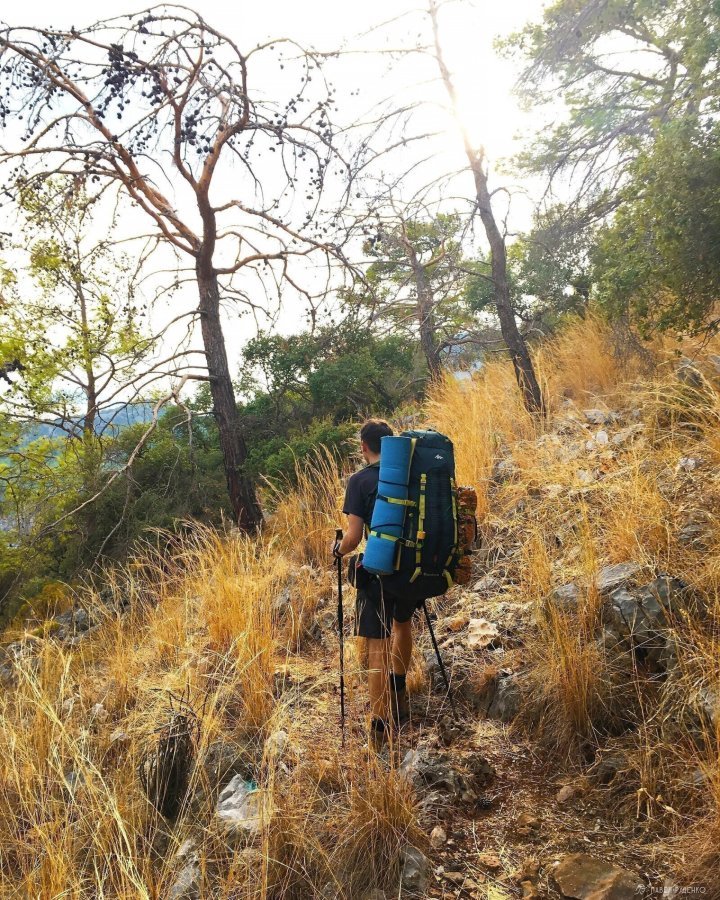
The weight of my backpack on the route was about 16 kg without water. Heavy synthetic sleeping bag, heavy tent, etc., now the weight would be significantly lower.
I work with gear, study it, because it helps to explore the world. Follow me on Instagram.Also watch the video about gear for the Lycian Way.
EXPENSES
Everyone's expenses are different, but for a general idea, I'm giving my expenses for 2 people.
Food, 5,000 RUB: 6 times we bought cookies, milk, sausages, cereals, cheese, bread, etc. in stores, average check 700 RUB, we didn't go to cafes.
Two overnight stays, 3,000 RUB: one in Antalya, one in Adriasane (to wash, recharge).
Buses on the route, 1,000 RUB.
Airfare, 8,500 RUB: Moscow - Antalya - Moscow. For two, 17,000 RUB.
Total for two: 26,000 RUB.
Return to previous parts


